FIELD STUDY
Resistance as a Condition for Organisation
External resistance can make otherwise invisible bodily relationships perceptible.
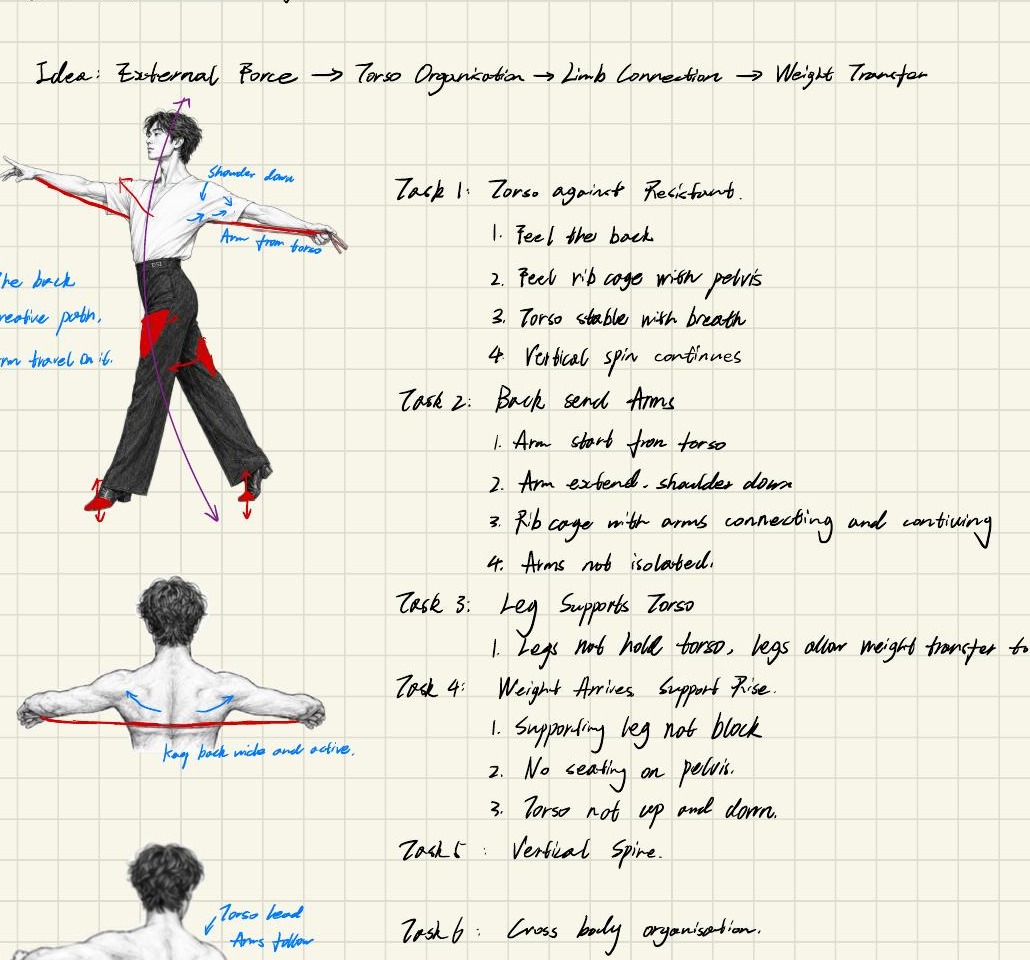
During a teaching session, students performed weight transfer and rotation while working against the continuous pull of a resistance band.
One student described a change in perception: transferring weight no longer felt like sending the body downward. Instead, the standing leg and the floor appeared to support the body while the band continuously drew it back towards its previous centre.
The resistance did not produce the movement. It made the organisation required to sustain the movement more perceptible.
The torso had to remain connected rather than collapse under the transfer of weight. The arms could no longer operate as isolated parts; their pathways had to continue through the back and ribcage. The standing leg became a connection between the floor, pelvis, and torso rather than a rigid structure holding the body in place.
During rotation, the external pull also clarified the function of the vertical spine. The body had to rotate around an organised axis rather than throw the axis into the direction of the turn.
- EXTERNAL FORCE
- TORSO ORGANISATION
- LIMB CONNECTION
- WEIGHT TRANSFER
- ROTATION AROUND THE VERTICAL SPINE
Principle
The band does not organise the body. It creates a condition in which the presence or absence of organisation becomes perceptible.
Weight descends; support rises.
Research Question
Can external resistance help a dancer perceive and retain bodily organisation after the resistance is removed?
Current Status
Provisional field study based on teaching practice.
The study currently requires further testing across different bodies, movement speeds, resistance directions, and dance contexts.
The primary test is not whether the dancer can organise the movement while using the band, but whether that organisation remains after the band is removed and transferred back into dancing.