Organising Principles
Vertical Spine
The spine does not remain vertical to stop movement. It remains organised so movement can happen.
Dancers are often instructed to keep the spine vertical. The instruction is useful, but incomplete. When verticality is understood as a fixed shape, it can produce rigidity and interrupt the movement it was intended to support.
Verticality is not stillness. It is a changing organisation of body mass.
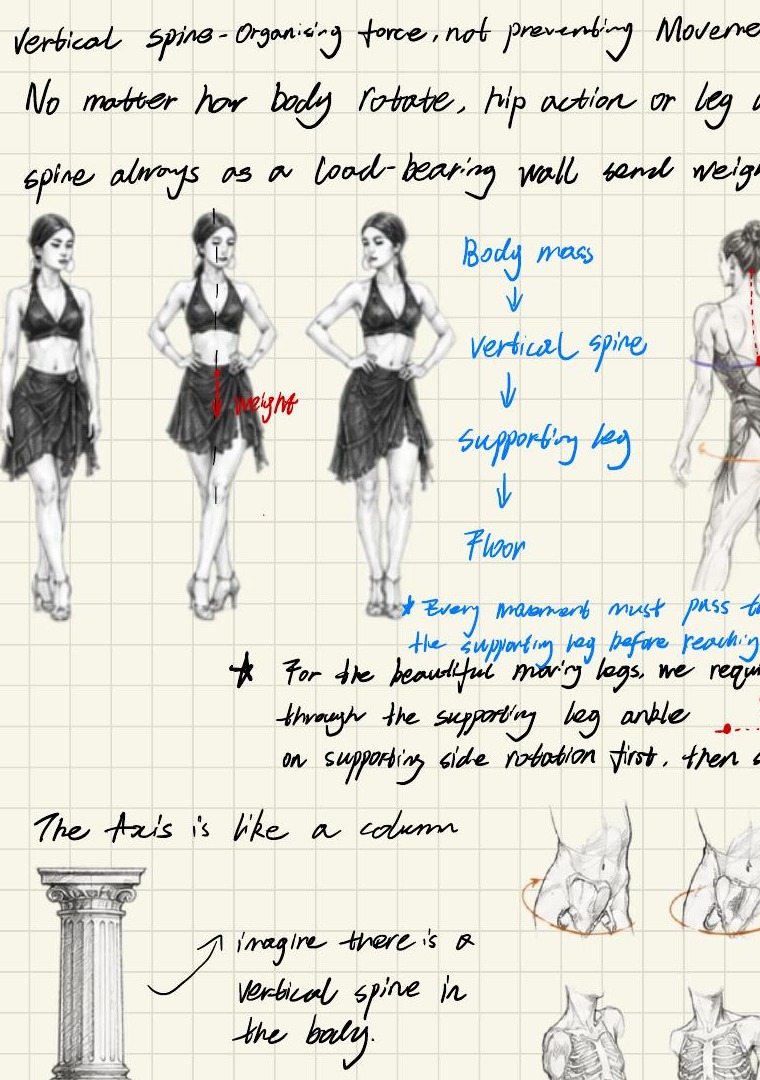
As weight moves, the pelvis, spine and rib cage continually adjust around the supporting leg. The spine remains load-bearing without becoming immobile. Rotation, lateral presentation and hip action can occur without abandoning vertical support.
The relevant question is therefore not whether the body bends or rotates. It is whether force can still travel coherently through the body, into the supporting leg and towards the ground.
- BODY MASS
- VERTICAL ORGANISATION
- SUPPORTING LEG
- GROUND
- LEFT SIDE
- CENTRE
- RIGHT SIDE
One side does not replace the other. The body reorganises through centre.
Principle
Verticality is not the absence of movement. It is the organisation that makes movement possible.
Movement Reading
Intention
Remain available while direction changes.
Organisation
Body mass is organised through the vertical spine, supporting leg and ground.
Embodied Experience
The body can rotate and expand without losing structural support.
Perception
Open, mobile and stable without appearing rigid.
Research Question
Can softness exist without collapsing vertical support?