Comparative Study
Five Latin Dances
Five temporal and bodily conditions within Latin dance practice.
This current study compares five Latin dances through body organisation, spatial organisation, temporal organisation, dynamic quality and shape change. The comparison comes from journal material that asks how rotation, weight-transfer timing and dance identity shape one another.
The terms Body, Space, Timing, Effort and Shape are reorganised here as five research labels: body organisation, spatial organisation, temporal organisation, dynamic quality and shape change. The change keeps the comparison close to the journal while avoiding a fixed external taxonomy.
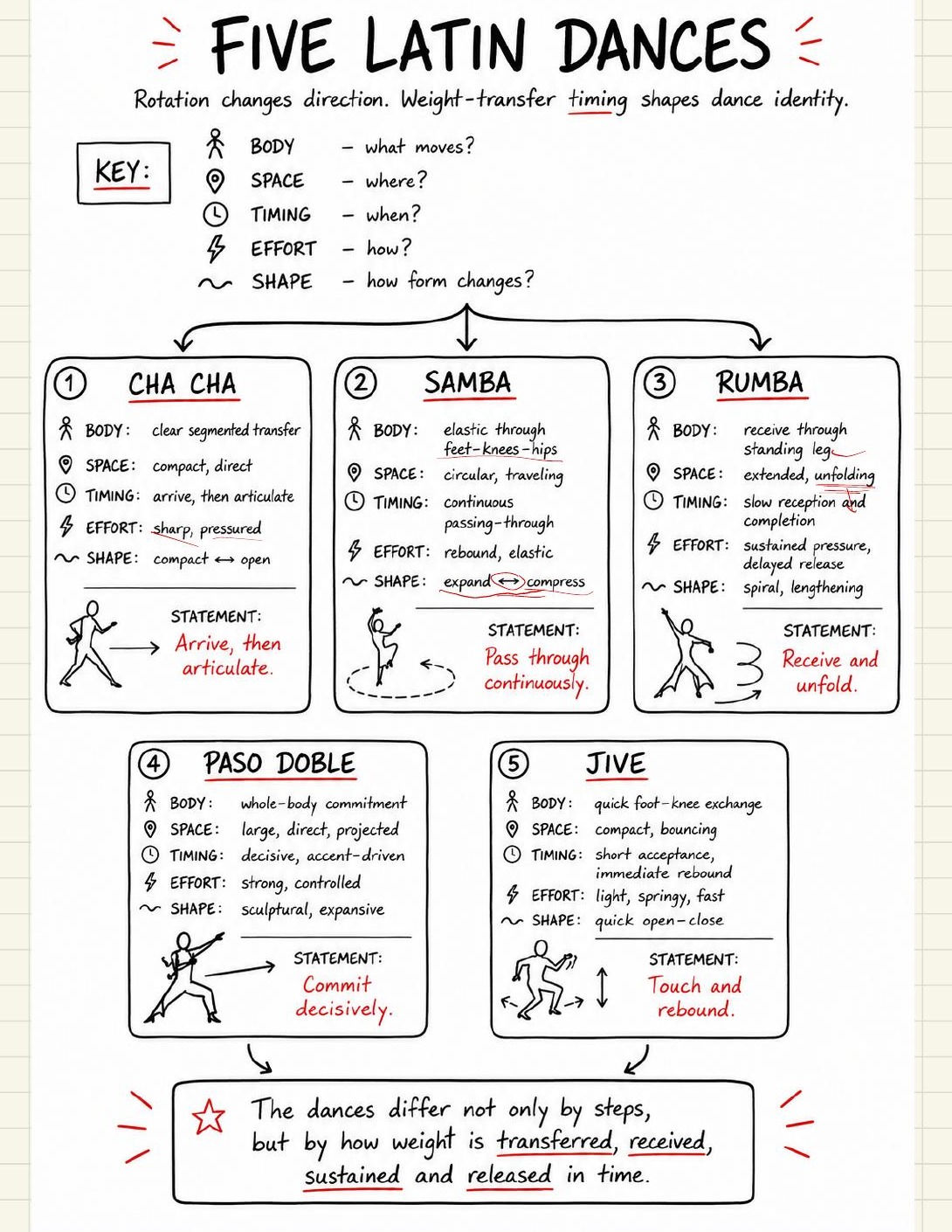
Cha-cha
- Body Organisation
- clear, segmented
- Spatial Organisation
- compact, direct
- Temporal Organisation
- , then articulate
- Dynamic Quality
- sharp,
- Shape Change
- compact ↔ open
Arrive, then articulate.
Samba
- Body Organisation
- elastic through feet–knees–hips
- Spatial Organisation
- circular, travelling
- Temporal Organisation
- continuous passing-through
- Dynamic Quality
- rebound, elastic
- Shape Change
- expand ↔ compress
Pass through continuously.
Rumba
- Body Organisation
- receive through the
- Spatial Organisation
- extended, unfolding
- Temporal Organisation
- slow reception and completion
- Dynamic Quality
- sustained , delayed release
- Shape Change
- spiral, lengthening
Receive and unfold.
Paso Doble
- Body Organisation
- whole-body commitment
- Spatial Organisation
- large, direct, projected
- Temporal Organisation
- decisive, accent-driven
- Dynamic Quality
- strong, controlled
- Shape Change
- sculptural, expansive
Commit decisively.
Jive
- Body Organisation
- quick foot–knee exchange
- Spatial Organisation
- compact, bouncing
- Temporal Organisation
- short acceptance, immediate rebound
- Dynamic Quality
- light, springy, fast
- Shape Change
- quick open–close
Touch and rebound.
Comparative Proposition
The dances differ not only by steps, but by how , received, sustained and released in time.