Latin Technique
Music & Timing
The step marks time; the body moves through time.
Music provides a continuous field of time. Counting translates that field into a dance structure. Step time marks where a foot action is placed, but body time describes the duration through which weight, pressure, rotation and support are organised.
The journal separates these layers so the step is not mistaken for the whole movement. A step may arrive on a count, while the body is still receiving, reorganising or completing another process.
- MUSIC
- COUNTING
- STEP TIME
- BODY TIME
- BODY ORGANISATION
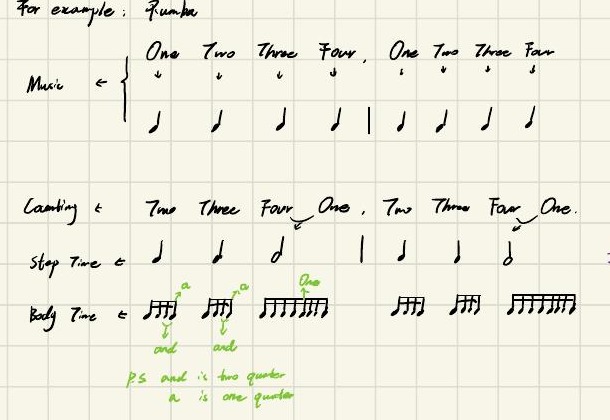
Rumba
- Metre
- 4/4
- Music
- 1 2 3 4 | 1 2 3 4
- Dance counting
- 2 3 4 1
- One beat as a microscope
- 2 - e - & - a
- Research emphasis
- and overlapping processes
Approximate body organisation
- 2
- e
/
- &
/ begins
- a
continues while onto the next support begins
These are not four isolated actions. The processes overlap.
One process may be resolving while the next has already begun.
Cha-cha-cha
- Metre
- 4/4
- Counting
- 2 3 4 & 1
- Research emphasis
- Compression of available time
Cha-cha-cha is not treated here as fast Rumba. Its compressed timing creates a distinct condition for , , the and the .
What changes when bodily organisation has to occur inside a shorter temporal interval?
Samba
- Metre
- 2/4
- Common dance rhythm
- 1 a 2
- Research emphasis
- Unequal subdivision
- Possible conceptual sequence
- compression -> release -> reorganisation
Not all subdivisions occupy equal durations. The relationship between subdivision and bodily action remains provisional; no fixed action is assigned to each count here.
Jive
- Metre
- 4/4
- Common dance count
- 1 2 3 a 4 5 a 6
- Research emphasis
- Triple rhythm /
Jive's a is not mechanically equivalent to Samba's a. Similar notation can contain a different bodily organisation.
How does the body repeatedly accept and release weight without losing continuity?
Comparative Summary
- Rumba
- Duration
- Cha-cha-cha
- Compression
- Samba
- Unequal Time
- Jive
- Rebound / Triple Rhythm
How does the body organise itself differently when time itself changes?
Principle
The step marks time; the body moves through time.
A step has a timing. The body has a duration.
Research Question
How does the body organise itself differently when time itself changes?